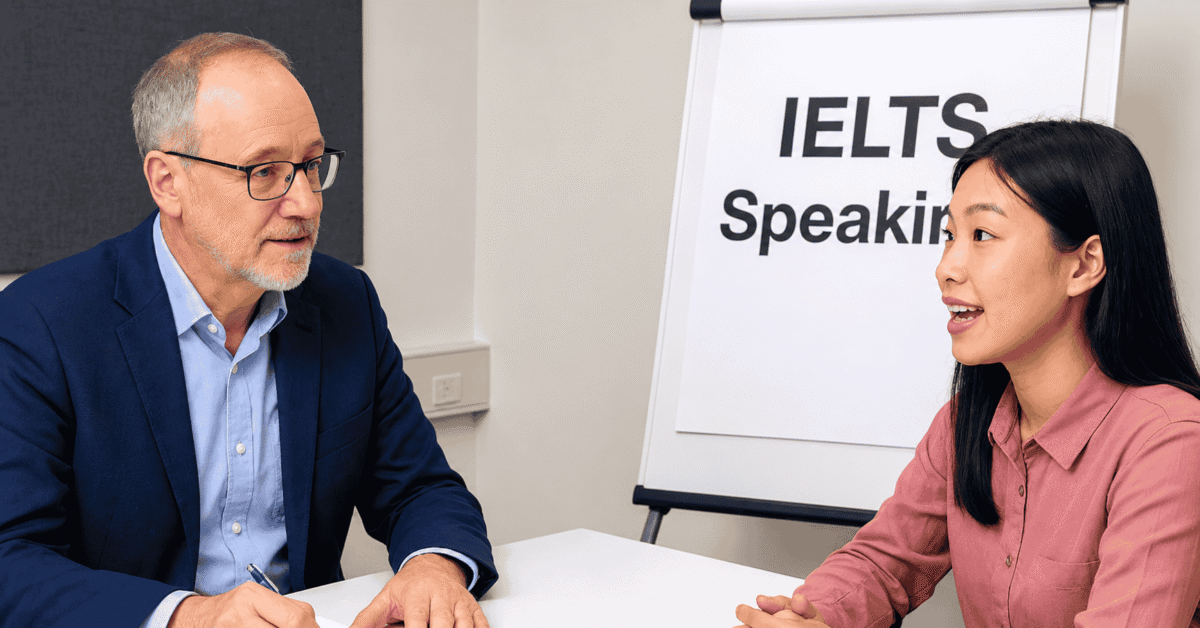
Preparing for the IELTS Speaking Test can feel challenging, especially if you are not confident speaking English. Many students understand English but struggle to express their thoughts clearly, answer questions naturally or speak without hesitation.
The good news is that regular practice and the right preparation can help you become a more confident speaker.
The IELTS Speaking Test evaluates your ability to communicate in English through everyday conversations, individual speaking tasks and discussions. Understanding the test format, practising common questions and learning how to develop your answers can make your preparation more effective.
In this blog, we will explore the IELTS Speaking Test format, common questions, sample answers for all three parts and useful tips to improve your speaking performance.
1. What Is the IELTS Speaking Test?
The IELTS Speaking Test is an assessment of your spoken English communication skills. It is conducted as an interview with a certified IELTS examiner and is recorded.
The test is the same for both IELTS Academic and IELTS General Training candidates.
The speaking test lasts approximately 11–14 minutes and consists of three parts. Each part checks different speaking abilities, from answering simple personal questions to discussing more complex topics.
2. IELTS Speaking Test Format
Before practising questions, it is important to understand how the speaking test works.
Part 1: Introduction and Interview (4–5 Minutes)
In this section, the examiner introduces themselves, checks your identity and asks general questions about familiar topics.
Common topics include:
Your hometown
Family and friends
Work and studies
Hobbies and interests
Daily routine
Food and shopping
Travel and holidays
The purpose is to understand how comfortably you can communicate about everyday subjects.
Part 2: Individual Long Turn (3–4 Minutes)
In this section, you receive a cue card with a topic and some points to cover.
You get one minute to prepare your answer and can make notes. After preparation, you need to speak for 1–2 minutes about the given topic.
The examiner may ask a short follow-up question at the end.
Part 3: Two-Way Discussion (4–5 Minutes)
This section includes more detailed questions related to the topic discussed in Part 2.
The examiner may ask you to:
Explain your opinions.
Compare different situations.
Discuss advantages and disadvantages.
Talk about changes in society.
Explain reasons and possible solutions.
This part checks how well you can express and develop ideas on broader subjects.
3. IELTS Speaking Part 1: Common Questions and Sample Answers
Part 1 focuses on familiar topics. Your answers should be natural, relevant and clear. Avoid giving only one-word answers.
Here are some commonly practised questions with sample answers.
Topic 1: Hometown
Q1. Where is your hometown?
Sample Answer:
My hometown is Khanna, a city in Punjab, India. It is a peaceful place with a friendly community. I have spent most of my life here, so I feel very connected to it.
Q2. What do you like most about your hometown?
Sample Answer:
The thing I like most about my hometown is its friendly atmosphere. People are helpful, and most places are easily accessible. I also enjoy the local food and the sense of community.
Q3. Has your hometown changed over the years?
Sample Answer:
Yes, my hometown has changed quite a lot. There are more shopping centres, better roads and new facilities than before. I think these developments have made life more convenient for residents.
Topic 2: Work and Studies
Q1. Are you working or studying?
Sample Answer:
I am currently working in the digital marketing field. My main responsibilities include website content, SEO activities and social media management. I enjoy this work because I get opportunities to learn new things.
Q2. Why did you choose this field?
Sample Answer:
I chose this field because I have always been interested in technology and online communication. Digital marketing is constantly changing, which makes the work interesting and gives me opportunities to improve my skills.
Q3. What do you enjoy most about your work?
Sample Answer:
I particularly enjoy creating content and analysing website performance. It feels rewarding when I see improvements in online visibility and engagement as a result of my efforts.
Topic 3: Hobbies
Q1. What do you like doing in your free time?
Sample Answer:
In my free time, I enjoy listening to music, watching movies and spending time with my family. These activities help me relax after a busy day.
Q2. Do you prefer indoor or outdoor activities?
Sample Answer:
I prefer outdoor activities because they give me an opportunity to get some fresh air and explore new places. However, I also enjoy watching movies at home when I want to relax.
Q3. Have your hobbies changed since childhood?
Sample Answer:
Yes, my hobbies have changed over time. As a child, I enjoyed playing outdoor games with friends. Nowadays, I prefer activities such as reading, listening to music and learning new skills.
Topic 4: Daily Routine
Q1. What is your usual daily routine?
Sample Answer:
I usually wake up in the morning, get ready and start my daily activities. During the day, I focus on my work and complete important tasks. In the evening, I spend some time relaxing and preparing for the next day.
Q2. Do you prefer mornings or evenings?
Sample Answer:
I prefer mornings because I feel more energetic and focused at that time. It is also easier to plan my day and complete important tasks without distractions.
Q3. Is your daily routine the same every day?
Sample Answer:
Not exactly. My basic routine remains similar, but some activities change depending on my workload and personal commitments.
4. IELTS Speaking Part 2: Cue Card Topics with Sample Answers
Part 2 requires you to speak continuously about a particular topic. You should use your one-minute preparation time wisely.
Here are some useful cue card topics for practice.
Cue Card 1: Describe a Person Who Inspires You
You should say:
Who this person is
How you know this person
What qualities this person has
And explain why this person inspires you.
Sample Answer:
A person who inspires me the most is my mother. She has always been supportive and encouraging throughout my life.
I have known her since childhood, of course, and she has played an important role in shaping my personality. One of her best qualities is her patience. She handles difficult situations calmly and always tries to find a solution instead of giving up.
I admire her because she manages different responsibilities while still making time for her family. Whenever I face a challenge, she motivates me to stay positive and work harder.
I believe she has taught me the importance of honesty, hard work and determination. That is why she is one of the most inspiring people in my life.
Cue Card 2: Describe a Place You Would Like to Visit
You should say:
Where the place is
What you know about it
Why you want to visit it
And explain what you would do there.
Sample Answer:
A place I would really like to visit is Switzerland. It is a beautiful country in Europe, famous for its mountains, lakes and natural scenery.
I have seen many pictures and travel videos of Switzerland, and I find its landscapes extremely attractive. The snow-covered mountains and peaceful surroundings make it look like a perfect holiday destination.
I would love to visit places such as Interlaken and Lucerne. I would also like to experience the scenic train journeys and try some local food.
The main reason I want to visit Switzerland is that I enjoy exploring beautiful destinations and experiencing different cultures. I believe visiting this country would be a memorable experience for me.
Cue Card 3: Describe a Skill You Would Like to Learn
You should say:
What the skill is
Why you want to learn it
How you would learn it
And explain how it would benefit you.
Sample Answer:
A skill I would like to improve is public speaking. I believe it is an important skill because communication plays a major role in both personal and professional life.
I want to develop this skill because speaking confidently in front of a group can sometimes be challenging. Good public speaking abilities can help people share their ideas clearly and make a positive impression.
To learn this skill, I would join a communication course, watch experienced speakers and practise speaking in front of friends or colleagues.
I believe improving my public speaking skills would increase my confidence and help me perform better in professional situations.
Cue Card 4: Describe a Memorable Day in Your Life
You should say:
When it happened
Where you were
What happened that day
And explain why you remember it.
Sample Answer:
One of the most memorable days in my life was the day I achieved an important personal goal.
It happened a few years ago when I had been working hard towards something that was very important to me. I remember feeling nervous because I was not sure whether my efforts would bring the expected results.
When I finally achieved my goal, I felt extremely happy and proud of myself. I celebrated the moment with my family, who had supported me throughout the journey.
I remember this day because it taught me that patience and consistent effort can lead to positive results. It also encouraged me to set new goals and continue improving myself.
5. IELTS Speaking Part 3: Discussion Questions and Sample Answers
Part 3 includes questions that require more detailed answers. You should explain your opinions and support them with reasons or examples.
Topic: Education
Q1. Why is education important in modern society?
Sample Answer:
Education is important because it provides people with knowledge and practical skills. It also helps individuals develop critical thinking and make better decisions. In modern society, education can create better career opportunities and contribute to economic development.
Q2. Do you think online education is as effective as traditional education?
Sample Answer:
I think both methods have their advantages. Online education offers flexibility and allows students to learn from different locations. On the other hand, traditional education provides direct interaction with teachers and classmates. The effectiveness of each method depends on the student’s learning style and the quality of teaching.
Q3. Should schools focus more on practical skills?
Sample Answer:
Yes, I believe practical skills should receive more attention in schools. Academic knowledge is important, but students also need communication, problem-solving and teamwork skills. These abilities can help them prepare for real-life challenges and future careers.
Topic: Technology
Q1. How has technology changed people’s lives?
Sample Answer:
Technology has made everyday life more convenient. People can communicate instantly, access information quickly and complete many tasks online. It has also transformed education, healthcare and business. However, excessive use of technology can sometimes reduce face-to-face interaction.
Q2. Do you think people depend too much on smartphones?
Sample Answer:
Yes, I think many people have become highly dependent on smartphones. They use them for communication, entertainment, shopping and even work. Although smartphones are useful, excessive usage can affect productivity and personal relationships.
Q3. Will technology replace traditional jobs in the future?
Sample Answer:
Technology may replace certain repetitive jobs, particularly those involving routine tasks. However, it will also create new career opportunities in areas such as artificial intelligence and digital services. I believe people will need to develop new skills to adapt to these changes.
6. How to Give Better Answers in the IELTS Speaking Test
Giving a good answer is not just about using difficult vocabulary. You need to communicate your ideas clearly and naturally.
Here are some useful strategies.
1. Extend Your Answers
Avoid giving very short answers, especially when the question allows you to explain your thoughts.
For example:
Question: Do you like reading?
Short answer: Yes, I do.
Improved answer: Yes, I enjoy reading, especially books about personal development. I find reading useful because it helps me learn new things and improve my vocabulary.
2. Use a Variety of Vocabulary
Try to use different words instead of repeating the same expressions.
For example:
Very good → Excellent
Very beautiful → Stunning
Very interesting → Fascinating
Very important → Essential
Very difficult → Challenging
Always choose words that fit the context. Do not use complicated vocabulary just to impress the examiner.
3. Practise Different Sentence Structures
Use a combination of simple and complex sentences.
For example:
Simple: I enjoy travelling.
Improved: I enjoy travelling because it allows me to explore new places, experience different cultures and meet interesting people.
4. Give Reasons and Examples
Whenever possible, support your answers with reasons or personal experiences.
Useful expressions include:
The main reason is that…
One example that comes to mind is…
From my experience…
I believe this is important because…
Another point worth mentioning is…
5. Speak Naturally
Do not try to sound like someone else. Speak in your normal voice and focus on communicating your ideas clearly.
A natural speaking style is more effective than using memorised sentences.
7. Common Mistakes to Avoid in IELTS Speaking
Many candidates lose confidence because they focus too much on avoiding mistakes instead of communicating naturally.
Here are some common mistakes to avoid:
1. Giving One-Word Answers
Try to develop your answers with relevant details instead of simply saying yes or no.
2. Memorising Complete Answers
Memorised responses may sound unnatural and may not answer the examiner’s actual question. Practise developing your own ideas.
3. Using Difficult Vocabulary Incorrectly
Using advanced words without understanding their meaning can make your answers confusing. Focus on accuracy and appropriate word choice.
4. Speaking Too Fast
Speaking quickly does not automatically improve your fluency. Maintain a comfortable pace so that your words are clear.
5. Ignoring Grammar
Pay attention to basic grammar, including tenses, articles, subject-verb agreement and sentence structure.
6. Giving Irrelevant Answers
Listen carefully to the examiner and make sure your response addresses the question.
7. Becoming Nervous After a Mistake
Small mistakes are normal. Correct yourself naturally if needed and continue speaking confidently.
8. Tips to Improve Your IELTS Speaking Band Score
If you want to improve your IELTS Speaking performance, regular practice is essential.
Here are some practical tips:
Practise speaking English every day for at least 15–20 minutes.
Record your voice and listen to identify mistakes.
Read English articles to improve vocabulary.
Practise speaking on unfamiliar topics.
Learn useful phrases and expressions in context.
Listen to English podcasts and interviews.
Practise cue cards within the given preparation time.
Take regular speaking mock tests.
Work on pronunciation, word stress and intonation.
Ask a teacher to evaluate your speaking performance.
Remember, improvement comes from consistent practice, feedback and identifying areas that need attention.
9. How Is the IELTS Speaking Test Scored?
IELTS Speaking is evaluated using four main assessment criteria.
Fluency and Coherence
This measures how smoothly you speak and how clearly you organise your ideas. Avoid unnecessary pauses and make sure your answers follow a logical order.
Lexical Resource
This evaluates your vocabulary range and how accurately you use words and expressions to communicate your ideas.
Grammatical Range and Accuracy
This measures your ability to use different sentence structures correctly, including both simple and complex sentences.
Pronunciation
This evaluates how clearly you pronounce words and use stress, rhythm and intonation to communicate meaning.
All four criteria are important. Candidates should work on improving each area rather than focusing only on vocabulary or speaking speed.
10. Frequently Asked Questions About the IELTS Speaking Test
Q1. How long is the IELTS Speaking Test?
The IELTS Speaking Test lasts approximately 11–14 minutes and consists of three parts: Introduction and Interview, Individual Long Turn and Two-Way Discussion.
Q2. Are IELTS Academic and General Training Speaking tests different?
No. The Speaking section is the same for both IELTS Academic and IELTS General Training candidates.
Q3. Can I use memorised answers in the IELTS Speaking Test?
It is better to avoid memorising complete answers. Instead, practise expressing your own ideas naturally and adapting your responses to the questions.
Q4. What happens if I make a grammar mistake during the test?
Making an occasional mistake is normal. If you notice an error, you can correct it naturally and continue speaking. Your overall performance is assessed across four criteria.
Q5. How can I improve my IELTS Speaking fluency?
Practise speaking English regularly, record your responses, learn to develop your ideas and participate in mock speaking tests. Consistent practice can help improve fluency and confidence.
Q6. Is pronunciation more important than vocabulary in IELTS Speaking?
Both are important, along with fluency and grammar. The examiner assesses all four criteria, so candidates should maintain a balanced approach to preparation.
Q7. Can I ask the examiner to repeat a question?
Yes. If you do not understand a question, you can politely ask the examiner to repeat it. Listen carefully before answering.
11. Prepare for IELTS Speaking with Think Excellence
Improving your IELTS Speaking skills requires more than learning sample answers. You need regular speaking practice, the right guidance and feedback to identify your strengths and weaknesses.
At Think Excellence Coaching and Immigration, students can work on improving their English communication skills and preparing for the IELTS examination.
Our IELTS preparation focuses on:
Speaking practice and fluency development.
Vocabulary building and grammar improvement.
Cue card practice and discussion topics.
Mock speaking sessions and performance feedback.
Guidance to improve confidence and communication.
Whether you are preparing for IELTS Academic or General Training, developing strong speaking skills can help you approach the test with greater confidence.
Start working towards your IELTS goals with Think Excellence.
Visit our IELTS Coaching Page to learn more about our IELTS preparation programmes.
Think Excellence – Think 9 Bands!